> For the complete documentation index, see [llms.txt](https://polymarketguide.gitbook.io/polymarketguide/llms.txt). Markdown versions of documentation pages are available by appending `.md` to page URLs; this page is available as [Markdown](https://polymarketguide.gitbook.io/polymarketguide/rules/consensus/source-credibility/evaluating-credibility.md).
# Evaluating Credibility
Source credibility can be evaluated using two useful signals: **media reliability** and **factual accuracy**.
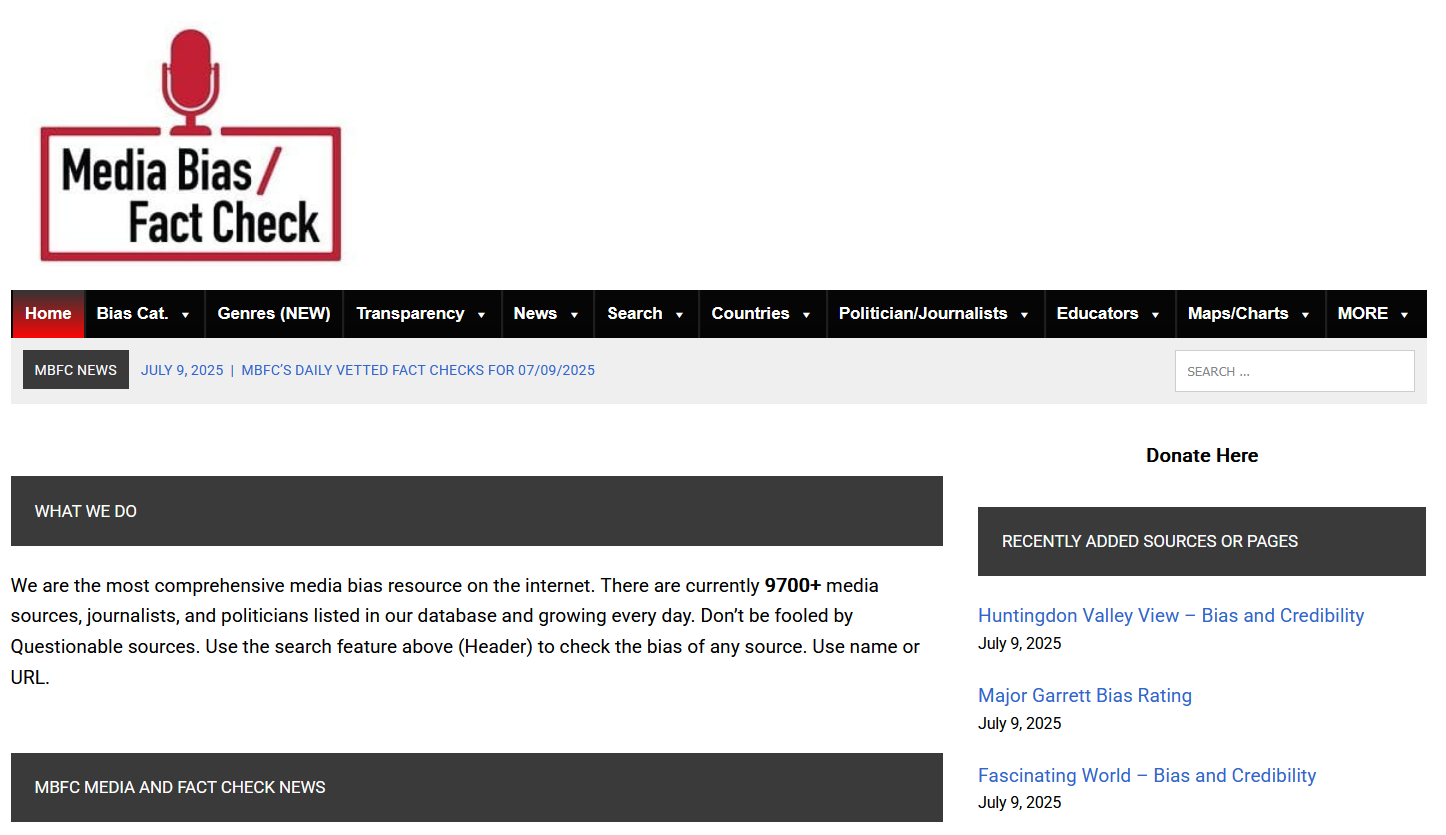
Two tools that make this easier are the [Ad Fontes Media Bias Chart](https://app.adfontesmedia.com/chart/interactive) and [Media Bias/Fact Check (MBFC)](https://mediabiasfactcheck.com/).
**Note:** Media-bias, reliability, and factual-accuracy ratings are subjective assessments, not definitive classifications. Different services may rate the same outlet differently.
### Ad Fontes
**Media reliability** means how dependable a news source is when reporting facts. Reliable sources focus on clear, accurate information rather than opinion or unsupported claims.
The [Ad Fontes Media Bias Chart](https://app.adfontesmedia.com/chart/interactive) shows both **reliability** and **political bias**.
* Sources near the **top** report facts carefully and use solid evidence.
* Sources near the **bottom** rely more on opinions or weaker information.
* Sources in the **center** are usually balanced, while those far to the **left** or **right** show stronger political leanings.
Sources near the **top** of the chart are generally more reliable, while their position from **left to right** shows political bias.
*Examples*: USAFacts, Pew Research Center, Reuters, and the Associated Press.
{% hint style="info" %}
Reliability and bias are different. A news outlet can lean left or right and still report facts accurately.
{% endhint %}
### MBFC
**Factual accuracy** means how truthful and careful a source is when sharing information. **Factually accurate sources** clearly separate facts from opinions and use trustworthy evidence.
You can check a source using [Media Bias/Fact Check (MBFC)](https://mediabiasfactcheck.com/). MBFC rates thousands of outlets and explains their **bias, factual reporting, and transparency**. Each profile explains why the source got that rating and gives examples of reliable or unreliable reporting.
For example, MBFC rates AP News as **least biased** and **very high** in factual reporting.
### Using Ad Fontes and MBFC
When you're not sure about a source, check Ad Fontes for its reliability and MBFC for its factual reporting. These tools are useful references, but they should not be used alone.
Established outlets generally have editorial standards, review processes, and correction policies that improve reliability. However, individual reporters can still make mistakes or bring their own perspectives, so the specific reporting still matters.
If something seems off, look at the source itself, its reporting history, possible agenda or incentives, the evidence it provides, and whether other credible sources support the same claim. A source can have a strong rating and still publish weak or misleading reporting in a specific case.